

it is not easy to assess, whether an intervention is value for money.
1. How can Health Economic Evaluation support evidence-based political decision-making?
2. What is the value of lung cancer screening?
3. Reduced medication for chronic diseases might save costs, but can this be achieved without compromising quality of life?
1. How can value for money be determined?

Photo: HCHE
The central question
Cost-effectiveness analysis evaluates the benefits of a technology relative to the current standard, taking costs into account. In many countries, it is a prerequisite for the implementation of new technologies or programs, gives decision-makers a number on value for money, and predicts the budget impact for healthcare systems.

Photo: HCHE
Resource scarcity forces decisions
Modelling can serve as a tool to determine the value of a technology relative to standard-of-care. The cost-effectiveness plane shows how the cost-effectiveness of new medical interventions is assessed compared to the current standard.
2. Is lung cancer screening a cost-effective measure?
Evaluation of a lung cancer (LC) screening program for heavy smokers, aged 55-75, who are at high risk.
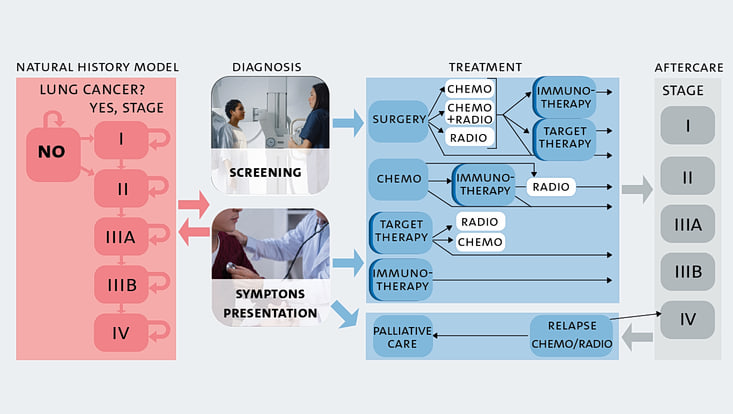
Photo: HCHE
The model
Modeling is an essential component of health economic evaluations and helps to illustrate the typical course from diagnosis to follow-up care. It divides disease progression into stages and links these to costs and quality of life (QALYs). The benefit of therapy can be calculated for up to 30 years.

Photo: HCHE
Results
Screening leads to earlier detection of lung cancer. However, it also incurs additional costs due to the screening itself, more frequent treatments, and longer follow-up care. Productivity gains from returning to the workforce only partially offset these expenses. Therefore, an additional economic burden remains.
3. What is the effect of dose reductions in patients with rheumatoid arthritis?
Approximately 1% of the German population suffers from rheumatoid arthritis. Treatment follows a treat-to-target approach, aiming for remission or at least low disease activity. In most cases, a combination of different medications is chosen, including biological drugs. They are fast, effective and expensive and carry risks, such as increased infection susceptibility

Photo: HCHE
Cost savings vs. quality of life
Less medication reduces treatment costs, but how much quality of life do we have to give up for this? If a patient has been stable on a specific dosage for a longer period of time, the model simulates a reduction in medication.

Photo: HCHE
Results
Dose reduction resulted in substantial savings, but also reduced quality of life. 50% dose reduction achieved the highest savings per QALY lost. Furthermore, an immediate 100% reduction is unlikely to be accepted due to risk aversion among patients and physicians.
Outlook: Can genome sequencing for rare and oncological diseases contribute to improved care?
A research team from Hamburg, Innsbruck, and Zurich is evaluating a new model project for genome sequencing on behalf of the National Association of Statutory Health Insurance Funds (GKV-Spitzenverband) from 2025 to 2030. Genome sequencing enables more precise diagnoses and targeted treatments individually tailored to the genetic characteristics of patients.

Photo: AdobeStock
Evaluation of the model project
The evaluation examines whether genome sequencing improves treatment and therapy options and how this affects costs. Furthermore, the process evaluation by stakeholders and an international comparison of the German approach are analyzed.

