

Declining revenues, too much spending— The financial situation is becoming increasingly precarious. How can this be fixed?
1. How did this imbalance come about?
2. What measures will correct the imbalance?
3. With finances under pressure, what options do insurers have in terms of competition?
1. A deficit of €15 billion is expected for 2027. How did this imbalance come about?
While the general statutory health insurance (GKV) contribution rate remains unchanged at 14.6% of gross income, average additional contributions have risen significantly recently.

Photo: HCHE
Insufficient growth of individuals with statutory insurance
- Labor productivity stagnates, growing just 0.6% per year
- Annual working hours have fallen by 5% since 2015
- Number of employees subject to social security contributions now falling
Chart: Number of contributors in millions

Photo: HCHE
Expenditures has risen much more sharply than Income
- Excessive and unnecessary use of healthcare services
- Inpatient care: most hospital cases in the OECD (>1 in 5 inhabitants per year)
- Outpatient care: among the OECD countries with the most doctor visits (14-18 visits/year)
-Drugs: among the countries with the most pharmaceuticals on the market and the highest prices
2. What's needed to increase income and reduce expenditure?

Photo: HCHE
Additional contributions to statutory health insurance
In 2025, the total budget of the statutory health insurance system, which insures 90% of the German population, was €356 billion. In addition to the fixed contribution rate of 14.6%, this includes rapidly increasing supplementary contributions.
Chart: Average additional contributions in percent

Photo: HCHE
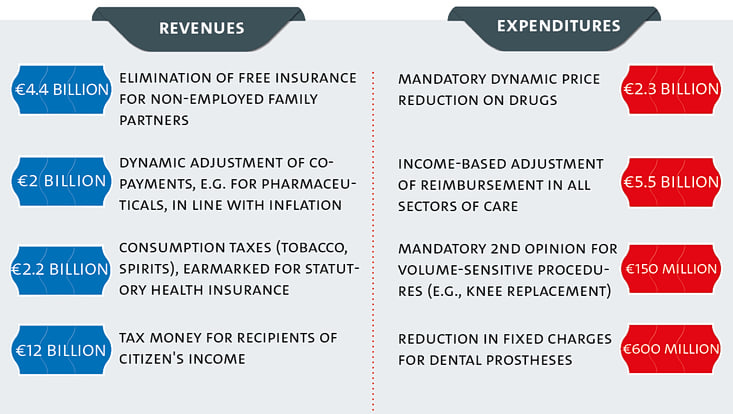
Measures to limit supplementary contributions
In order to limit supplementary contributions, a couple of short-term measures, among others, have been proposed (with potential savings amounts for 2027).

Photo: HCHE
Report of the Finance Commission
The Commission presented a report in March 2026 outlining short-term measures to be implemented from 2027 onwards. A further report on structural reforms from 2028 onwards will follow in late 2026, including proposals for reorganizing emergency care, introducing a mandatory gatekeeping system for primary care, and reforming drug prices.
3. Limited scope for statutory health insurers?
Since statutory health insurance plans are bound by the specific contribution rate and the catalog of services, their only means of differentiation are through the level of additional premiums and the supplementary benefits they offer. The contribution rate is the decisive factor when individuals change their health insurer.

Photo: HCHE
Who is more willing to switch?
Reasons for switching health insurance providers: Full-time employees are more likely to compare due to income-based contributions. Changes in insurance status (e.g., students, pensioners) may act as catalysts for reevaluating insurers. People in good health and families are significantly more price-sensitive and more willing to switch.

Photo: HCHE
Supplementary services can influence the decision to switch
The top 10 supplementary services include alternative medicines, reproductive benefits, and sports medicine examinations. They also include additional pregnancy examinations, professional teeth cleaning, osteopathy coverage, homeopathy, and travel vaccinations, the organization of 2nd medical opinions and skin cancer screenings.

Photo: AdobeStock
Some useful information
- Service cutbacks at the incumbent insurer act as push factors, increasing the propensity to switch
- Larger insurers have an advantage: Individuals tend to stay due to greater perceived stability, better administrative capacity, or stronger brand recognition

